Collagen, peptides and retinol: read beyond the product name
Collagen. Peptides. Retinol. These names can make two skincare products sound alike before you have even turned the packaging around. A closer look often reveals important differences. Here is a practical way to compare formulas without getting distracted by the biggest words on the jar.
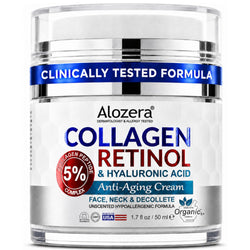
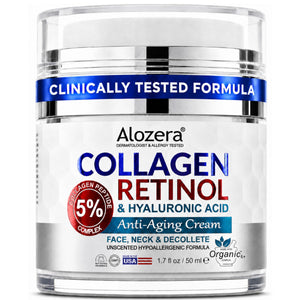
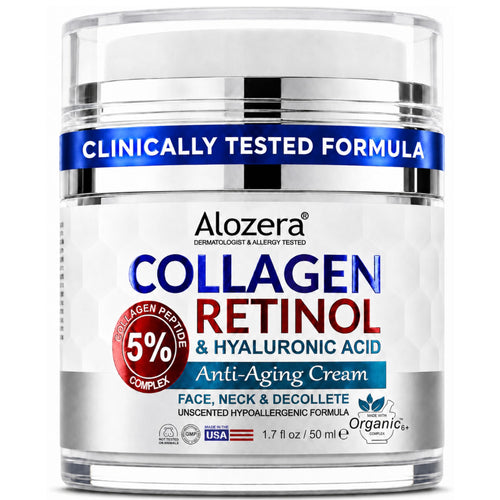
Read the complete ingredient name and the complete percentage claim. “5% collagen peptide complex” does not mean “5% retinol.”
First, separate the three names
Collagen, peptides and retinol are not interchangeable terms. They may appear together in a product, but a headline featuring one does not tell you the identity or amount of the others.
| On the front | What to check next |
|---|---|
| Collagen | The specific ingredient listed, such as hydrolyzed marine collagen |
| Peptide complex | The named blend and its component ingredients where provided |
| Retinol or Vitamin A language | The exact Vitamin A ingredient in the full list |
| A percentage | Which ingredient or complex the number describes |
A real example: the 5% claim
The label on Alozera Collagen Peptide + Retinol Face Cream identifies a 5% collagen peptide complex. Read the number together with those words. It is not a statement that the cream contains 5% retinol.
This is a useful habit for any skincare comparison: do not lift a percentage out of its sentence. A number can describe a blend, and that does not establish the percentage of every individual ingredient inside it.
Similar names can hide different formulas
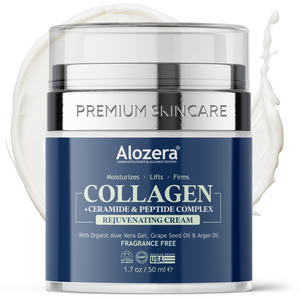
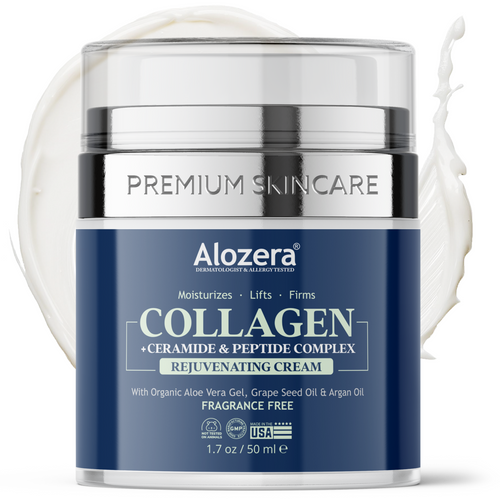
Alozera Collagen Face Cream is a separate product. Its supplied ingredient list includes hydrolyzed marine collagen, a ceramide/peptide complex and retinyl palmitate.
Retinyl palmitate and retinol are different ingredient names. Do not silently replace one with the other when comparing labels. The most useful comparison is the actual ingredient list for the exact jar you are considering.
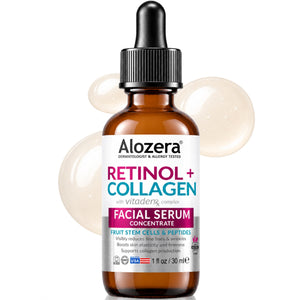
The same principle applies to Retinol + Collagen Facial Serum. A serum and a cream with related names remain separate formulas, with their own directions.
The four-point comparison you can use today
- Match the exact product. Check the name, format and size so you are not comparing information from a different item.
- Read the Ingredients accordion. Highlight the exact names you care about rather than relying on the shortened product title.
- Read every number in context. Ask whether it refers to one ingredient, a complex or something else entirely.
- Finish with Directions & care. A label comparison is incomplete without knowing how the product is intended to be used.
What a label cannot tell you by itself
An ingredient name is not a promise of a specific result or timeline. Nor does a familiar complex establish that two finished products will feel the same. Texture, packaging, intended area and directions all matter when deciding what fits your routine.
Choose a clear role for the product before adding it to your shelf. A simpler routine with a deliberate choice is easier to understand than several overlapping products purchased for similar-sounding names.
Quick questions
Is the Collagen Face Cream the same as the Collagen Peptide + Retinol Face Cream?
No. They are separate Alozera products. Use each product’s own ingredient list and directions.
Does a larger percentage automatically make a product the better choice?
No. First establish what the percentage measures. Then compare the complete formula and whether its format suits your needs.
Where should I start browsing?
Explore the firming and fine-lines collection, then compare a small shortlist using the four checks above.